

By Ikechukwu Henry
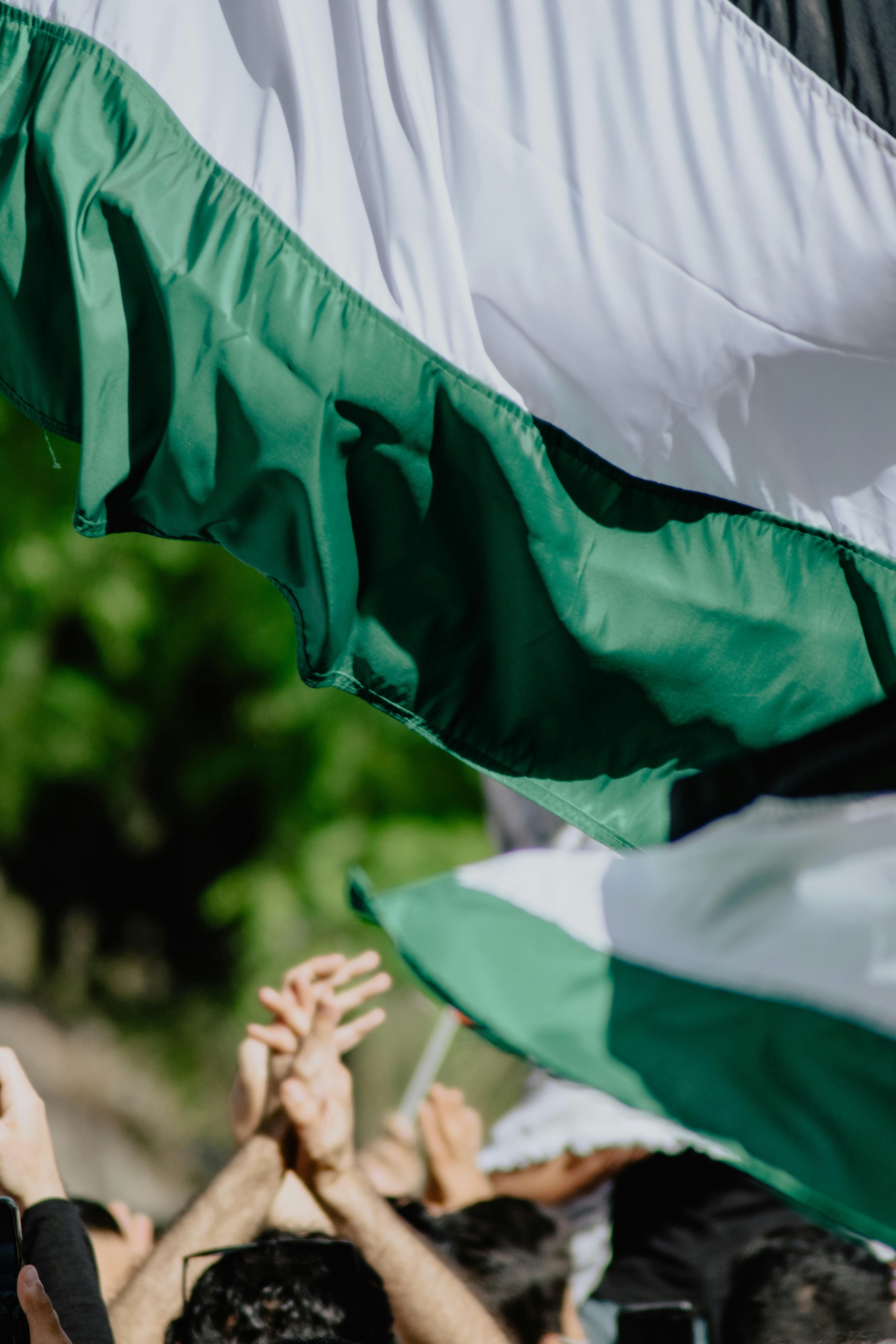
Image credits to Mohamed Jamil Latrach on Unsplash
I had risen before dawn, as I always did on this day, when the air still carried a kind of coolness that disappeared once the sun found its strength. My hands had already reached for the flag before I fully thought about it. It lay folded inside the bottom drawer of the cabinet where I kept old exam registers and lesson notes from years of teaching. The fabric had grown frail over the years, its green faded to something like river water, the white dulled into the yellow of old pages. I touched it with care, the way one touches skin that has scarred but never healed.
From the veranda, I could already hear the city rousing itself. Loudspeakers somewhere down the street were sputtering out martial tunes, and children were shouting in the kind of shrill excitement that made my heart ache. They would wear paper crowns today, paint their faces in green and white, march behind drums that boomed as though the earth itself were shaking. It was the same noise that had filled the streets the day my husband had left home and never returned. Whenever I heard it, my body remembered before my mind did.
I pinned the cloth to the railing with the same wooden clips I had used for years. The gesture was practiced, almost mechanical, but my chest felt unsettled, as though it were both constricting and expanding at once. When the flag was up, it did not flutter as it once had, not full and proud. It sagged against the railing, weary, like a body that had carried too much. I stood there, looking at it, until a pair of footsteps behind me pulled me back to the present.
I turned and saw Emeka. He had not told me he was coming, and perhaps it was good he had not, for I would have sat awake in anxious worry all night. He carried a single bag in one hand and his shoulders were squared in that way men carry themselves when they do not want to admit to fatigue. His hair had grown gray along the edges, which startled me more than the years of his absence. For a brief moment, I remembered him as a boy running into the house with scraped knees, his face tilted toward me, waiting for my comfort. Now he looked at me as though he were measuring the distance of a stranger.
We greeted with words that were formal and shallow, words that filled the air but did not bridge anything between us. Then his eyes moved past me to the flag on the railing. His gaze stayed fixed, heavy, as if the cloth itself were some kind of intruder. I saw his jaw tighten, his mouth pressing into a thin line.
“You still do this,” he said. His voice was flat, but beneath it I heard a crack, a wound that had never closed.
I wanted to answer him with something easy, something that would settle the moment, but the words that came out were stiff. “It is tradition. It is respect.”
His eyes shifted back to me, searching my face. But I gave him nothing, not because I wanted to withhold, but because I had lived too long carrying grief beneath my ribs, hidden from the world. My face had learned how to hold steady even when the inside of me shook. He thought it was strength; he thought it was pride. But it was simply survival.
Emeka moved past me into the sitting room, leaving his bag by the door. I watched him as one might watch a storm approaching—aware that nothing I did would change its path. He sat, but his posture was restless, and I knew his thoughts had not followed his body into the chair. His eyes kept drifting toward the veranda, where the faded cloth hung.
That gaze of his carried blame. I had known it since he was a boy, when he asked me questions I could not answer. Why did Papa not come back? Why do you cry when the drums beat? Why do you never talk about him? Over the years, I learned to respond with silence. It was not the kind of silence that meant I did not care, but the kind that meant words were not enough.
I walked into the kitchen to fetch water, though neither of us was thirsty. I needed something to hold, something to busy my hands. The clink of the cup on the tray was steady, unlike the uneven pounding of my heart.
When I returned, Emeka had leaned forward, his elbows on his knees. He looked at the flag again before speaking, his voice edged with irony. “Still with the patriotism, Mama?”
I placed the cup before him, careful not to meet his eyes just yet. “It is respect,” I repeated. The words sounded thin, like a note played on an old flute.
Respect for what, he wanted to ask. I saw it in the way his brow furrowed, in the way he inhaled sharply and let the breath out through his nose. He thought I had married my grief to the nation. He thought the flag was loyalty to a country that had swallowed his father and left us with nothing. He did not know that I never thought of Nigeria when I hung it.
As he stared, I slipped back into the memory that clung to me each year. October 1960. The city was alive with newness, voices rising in chants, streets filled with marching and music. But I remembered none of that clearly. What I remembered was fabric. A length of cotton, cheap but bright, sold by a trader outside Ogbete market. I had bought it because the colors were cheerful, because it seemed fitting for a day that promised change. Hours later, it was all I had to cover my shaking hands when they told me my husband had been struck, his body crumpled on the road. The world around me roared with jubilation, and I was clutching that green-white-green cloth, trying to believe I had not just become a widow.
The years made the cloth smaller, weaker, but I kept it. I stitched its edges when they frayed, pressed it flat each September in preparation for October. When I pinned it up, I was not celebrating a country. I was remembering that I had not died with him. That I had kept on living, if only for the boy now grown into a man sitting across from me.
But these were thoughts I could not offer him yet. I feared that if I tried, they would spill out as something jagged, something he would not accept. So I said nothing more. I sat in the chair opposite him, holding my own cup, watching the faint ripples on its surface.
Outside, the voices of children swelled. I knew the streets would soon fill with parades, the colors freshly painted, their white far brighter than the one that drooped on my veranda. And I felt Emeka’s resentment settling between us, as present as the flag itself.
The house had always been a buffer, its walls steady, its rooms arranged in the way I liked them. But that day, every wall seemed porous. The noise from outside pushed its way in—the radio from the next compound, the shrill of whistles, children clapping as they sang songs of freedom they could not yet understand. Each sound entered the room and lodged itself between Emeka and me.
He stood near the window, shifting, his back stiff. I sat on the sofa with my wrapper drawn close, my hands pressed flat against my knees. He had always been restless when he was unsettled, even as a child, and now I could feel his energy prickling across the room.
“Do you ever tire of it?” he asked suddenly, his tone sharp, as though the question had been building since the moment he arrived.
I looked at him carefully. “Of what?”
“This performance,” he said, gesturing toward the veranda. “Every year, you bring that thing out. Every year, like clockwork. I used to think it was patriotism. Now I know better—it’s obsession.”
His words were a blow, though not unexpected. I had seen the bitterness forming in him since boyhood. Still, hearing it so plainly brought heat to my face.
“It is remembrance,” I said, my voice low. “Respect.”
“For him or for them?” His eyes were fierce now, glinting with a hurt I had not wanted to face. “For my father, or for the country that killed him?”
The room seemed smaller suddenly, the air thick. The drums outside had grown louder, nearer, as if to mock us.
I inhaled, steadying myself. “Do not speak as though you understand what that day was.”
“I understand enough,” he snapped. “I remember his coffin draped with that same cloth. I remember neighbors praising him as though he were some martyr of independence, when all I saw was a boy burying his father. And you—you made it worse. You never cried for him as my father. You turned him into a symbol, Mama. You gave him to the nation, not to me.”
I could not bear the way he looked at me, accusing, as if the years of labor and sacrifice I had poured into raising him were erased by one flag. I gripped my knees harder.
“You think I chose that?” I said finally. My voice trembled in a way I had not allowed in years. “You think I wanted to bury my husband with chants ringing outside? To carry a child while holding the news of death in my belly? You think I hung that flag for them?”
The words came too quickly, too raw. He was silent, his mouth set, his eyes searching mine. Outside, the parade erupted with cheers as a marching band struck up a tune, the horns brash, the cymbals clashing.
I turned my head slightly toward the veranda. That cloth fluttered faintly in the breeze, faded and frail, yet still visible. My heart pulled me toward memory again, the way it always did when he pushed me with his anger.
I was there once more: in the hospital corridor, the nurse’s voice distant, the smell of disinfectant sharp. The fabric in my hands—green, white, green—creased from being held too tightly. I had pressed it to my face because it was clean, because it was the only thing between me and the news that had crushed me.
I had never told him that. I had never told anyone. But I felt the pressure of it now, rising like water against a dam, ready to break.
I rose from the sofa slowly, each step toward the window weighted. Emeka did not move; he only watched me, his shoulders rigid, his jaw clenched in the way that made him look so much like his father.
“You want to know why I hang it?” I asked. My voice was steadier now, though something inside me quivered. “Sit, and listen.”
He stayed standing, but his eyes did not leave me. That was enough.
I walked to the veranda doorway, held the railing where the cloth hung. It sagged a little on its stick, its edges frayed from years of folding and unfolding. I touched it lightly, the way one touches an old wound that has long scarred but still aches.
“The day your father died, I had nothing,” I said. “Nothing but the wrapper around my waist and this flag. I carried it with me because he had bought it that morning. He wanted to march with it. He said it would be history.”
The drums outside pounded louder, the brass notes rising, as though the street wanted to drown me out. But the words pressed forward anyway.
“I was still young,” I continued, “barely more than a girl with a child on her hip. And when they told me he was gone, when they showed me his body, I had no cloth to cover my face, no white handkerchief, no wrapper I could soil. All I had was this flag. I pressed it here.” I laid my hand across my cheek. “It soaked my tears, not the nation’s. Mine.”
I turned back to him then. His stance had softened, his fists no longer tight. His eyes darted to the flag, back to me, then down to the floor as though he were unsure of where to rest them.
“For years, I could not let it go,” I said, softer now. “It was the only thing that touched me that day and stayed. Every October, I bring it out because it reminds me I lived. That I did not lie down beside him and disappear. That I chose to stay, to raise you.”
He swallowed hard, his Adam’s apple shifting. I could see his chest rise and fall more heavily, as if breathing had become a struggle.
All around us, the parade raged. Children’s voices cracked with excitement, adults clapped to the beat, radios blared speeches about unity and freedom. None of them knew that above their heads, this old cloth did not speak for a nation. It spoke for one woman, who had lost everything in a single day and held on to the only fabric she could.
I waited. For years I had feared this moment—that my son would spit back my truth, dismiss it as weakness, call it madness. But his face told another story. His anger was still there, yes, but tangled now with something else: confusion, recognition, perhaps even shame.
He sank slowly onto the chair by the window, his gaze lowered. I stood by the railing, the flag brushing lightly against my hand. For the first time in decades, I had spoken it aloud.
And in the space between us, something shifted, something I had thought too late to save.
***
The veranda was cooler than the living room, a relief after hours of noise and heat pressing through the windows. I stepped out first, needing the air, needing space for my thoughts to settle. Mama followed, slower, her frame bent in a way that seemed older than her years. She sat down on the wooden chair she always kept by the railing, the one with a worn cushion that sagged in the middle.
The flag was still there, swaying faintly. I looked at it, but it no longer pierced me the way it had in the morning. The green was faded, the white stained at the edges, yet it carried the weight of her words. Not the speeches from the radio, not the children outside with paint on their cheeks, not the brass band that had tramped down the road. Just her story—pressed tears, survival, the choice to stay alive for me.
For years, I had believed she loved the cloth more than she loved me. That each Independence Day she picked the nation over the boy left behind by a dead father. That belief had been my shield against her distance. Now I saw it was my own blindness, my own need to blame.
She shifted in her chair and turned her eyes to the street. “The noise will soon fade,” she said.
I sat opposite her. Between us, the flag fluttered, its sound small against the last echoes of the parade. I studied her face. The lines were deeper than I remembered. Her hands, folded in her lap, trembled slightly. She was not the figure of iron I had carried in my mind all these years. She was a woman who had been asked to lose everything and still stand up the next morning.
I thought of my own children—how I held their hands crossing busy streets, how I sometimes stood at their doors at night listening to their breathing. What if I had lost their mother in a single flash of violence, on a day the whole country was celebrating? Could I have carried on? Could I have chosen survival, day after day, when grief pressed itself into the air you breathed?
I wanted to say something, to apologize for my years of absence, for the cutting words I had thrown at her. But my throat felt dry. Words seemed useless now, too thin to carry the weight of what I owed.
Instead, I placed my hand carefully over hers. Her fingers stiffened first, then relaxed, curling faintly as if testing whether my presence was real.
We sat like that, watching the flag.
The street had quieted. A few boys still kicked a plastic ball against the wall near the junction, their laughter carrying faintly, but the blaring radios and brass bands had dissolved into the day’s residue. The air felt softer now, the kind of calm that followed after a stormy celebration.
Mama rose slowly from her chair. Her knees seemed stiff, and I almost reached to help her, but she waved her hand lightly as if to say she still had strength for small tasks. She walked toward the flag. I followed, my steps uncertain, my eyes fixed on that cloth.
She touched it first, her fingers lingering on the frayed edge. Then she turned her head toward me. “Come,” she said, not commanding, not pleading, but inviting.
I stepped closer, and together we unclipped the small pole from the railing. The flag drooped in her hands, lighter than I expected. I remembered it as something larger, heavier, almost monumental. But now, up close, it was nothing more than thin fabric—worn cotton that had carried too much meaning for too long.
She held one end out to me. “Help me fold.”
The gesture felt like an offering. I took the end carefully, smoothing the edge between my fingers. We bent toward each other, folding once, then again, her movements practiced and steady. My hands trembled slightly, not from the fabric but from the weight of what we were doing—closing a ritual that had lived between us like a locked door.
As we folded, memories crowded in. The day of the funeral—me clinging to her wrapper, my head too small to understand the speeches men gave about sacrifice and freedom. The years after, when she stood on this same veranda, raising the flag as if speaking to ghosts. My own decision to leave, to let distance become my answer.
Now, in this act, I saw the truth: the flag had not been about a country or its hollow parades. It had been her way to hold something clean in the middle of ruin, to carry forward without collapsing.
When the last fold was done, the flag sat neatly between us, a small bundle, its colors muted but intact. Mama pressed it against her chest for a moment, then placed it gently on the chair.
Neither of us spoke. But the air between us felt different, no longer charged with resentment. There was sorrow, yes, but also a thread of understanding strong enough to bridge ten lost years.
I looked at her, at the tired curve of her shoulders, and said softly, “I see it now.”
She met my eyes. No tears, no speeches. Just a faint nod, the kind that said she had been waiting for this—not forgiveness, not apology, just acknowledgment.
We sat side by side as the last light slipped from the street. The flag rested on the chair, folded, no longer a wedge between us but a thread binding us together.
And for the first time in decades, I felt at home.
The End.
Read the pervious story here .
This was such a good read.